1. what are the different portals of entry for a pathogen to enter the body?
The spread of an infection within a community is described as a "chain," several interconnected steps that draw how a pathogen moves most. Infection control and contact tracing are meant to break the concatenation, preventing a pathogen from spreading.
Emerging infectious diseases are those whose incidence in humans has increased in the past two decades or are a threat to increase in the near futurity. These diseases, which can chop-chop spread across national boundaries and communities, may claiming the ability of public wellness systems to prevent and command the spread of the disease, specially in resource-limited countries and regions.
The spread of infection can be described every bit a chain with vi links:
- Infectious agent (pathogen)
- Reservoir (the normal location of the pathogen)
- Portal of exit from the reservoir
- Mode of transmission
- Portal of entry into a host
- Susceptible host
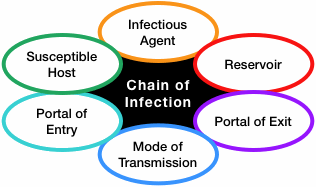
Infection command measures are designed to break the links and thereby preclude a pathogen from spreading.
Infectious Agents
Infectious agents (pathogens) include not merely bacteria simply also viruses, fungi, and parasites. The virulence of these pathogens depends on their number, their potency, their ability to enter and survive in the torso, and the susceptibility of the host. For example, the smallpox virus is particularly virulent, infecting almost all people exposed. In contrast, the tuberculosis bacillus infects only a pocket-sized number of people, usually people with weakened immune function, or those who are undernourished and living in crowded weather.
Viruses are intracellular parasites; that is, they can but reproduce inside a living cell. Some viruses, such as HIV and hepatitis B and C, take the ability to enter and survive in the body for years before symptoms of disease occur. Other viruses, such as influenza and COVID-19, quickly denote their presence through characteristic symptoms.
Reservoir
A reservoir is any person, fauna, arthropod, plant, soil or substance (or combination of these) in which an infectious amanuensis commonly lives and multiplies. The infectious agent depends on the reservoir for survival, where it can reproduce itself in such manner that it can be transmitted to a susceptible host.
Animate reservoirs include people, insects, birds, and other animals. Inanimate reservoirs include soil, water, food, carrion, intravenous fluid, and equipment.
Portal of Exit
Portals of exit is the means by which a pathogen exits from a reservoir. For a human being reservoir, the portal of get out can include blood, respiratory secretions, and anything exiting from the gastrointestinal or urinary tracts.
In one case a pathogen has exited the reservoir, it needs a mode of transmission to transfer itself into a host. This is accomplished past entering the host through a receptive portal of entry. Manual tin be by direct contact, indirect contact, or through the air.
Manual of respiratory infections such as COVID-19 is primarily via virus-laden fluid particles (i.e., droplets and aerosols) that are formed in the respiratory tract of an infected person and expelled from the rima oris and nose during animate, talking, singing, coughing, and sneezing. The competing furnishings of inertia, gravity, and evaporation make up one's mind the fate of these aerosol. Large aerosol settle faster than they evaporate and contaminate surrounding surfaces. Smaller droplets evaporate faster than they settle, forming droplet nuclei that tin can stay airborne for hours (becoming aerosolized) and may be transported over long distances (Mittal et al., 2020, July 10).
Human-to-human transmission of COVID-xix occurs primarily via three routes: (1) large particles that are expelled with sufficient momentum so as to directly impact the recipients' oral fissure, nose, or conjunctiva; (two) concrete contact with droplets deposited on a surface and subsequent transfer to the recipient's respiratory mucosa; and (three) inhalation of aerosolized droplet nuclei delivered by ambient air currents. The kickoff ii routes associated with large droplets are referred to equally the "droplet" and "contact" routes of transmission, whereas the tertiary is referred to every bit "airborne" transmission (Mittal et al., 2020, July 10).
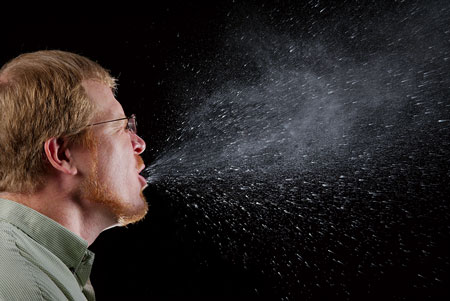
This photograph captures a sneeze in progress, revealing the plume of salivary droplets as they are expelled in a big cone-shaped array from this man'south open mouth, thereby dramatically illustrating the reason for covering your mouth when coughing or sneezing, in order to protect others from germ exposure. Source: James Gathany, CDC PHIL, 2009.
Airborne (Droplets) Transmission
The main mode by which people are infected with SARS-CoV-2 is through exposure to respiratory fluids carrying infectious virus. Exposure occurs in iii principal ways: (1) inhalation of very fine respiratory aerosol and droplets particles, (2) degradation of respiratory droplets and particles on exposed mucous membranes in the mouth, olfactory organ, or middle past directly splashes and sprays, and (3) touching mucous membranes with hands that have been soiled either directly by virus-containing respiratory fluids or indirectly by touching surfaces with virus on them (CDC, 2021, May 7).
People release respiratory fluids during exhalation (e.grand., quiet breathing, speaking, singing, do, coughing, sneezing) in the course of droplets beyond a spectrum of sizes. These droplets carry virus and transmit infection.
- The largest droplets settle out of the air chop-chop, within seconds to minutes.
- The smallest very fine aerosol, and aerosol particles formed when these fine droplets rapidly dry, are modest enough that they can remain suspended in the air for minutes to hours. (CDC, 2021, May 7).
Aerosols are modest particles (≤five μm) that can rapidly evaporate in the air, leaving behind droplet nuclei that are minor enough and light plenty to remain suspended in the air for hours (Klompas et al., 2020). Airborne manual can occur when the residue of evaporated droplets from an infected person remain in the air long enough to exist transmitted to the respiratory tract of a susceptible host.
In one case infectious aerosol and particles are exhaled, they move outward from the source. The take a chance for infection decreases with increasing distance from the source and increasing time after exhalation. 2 principal processes decide the amount of virus to which a person is exposed in the air or by touching a surface contaminated by virus (CDC, 2021, May vii):
- Decreasing concentration of virus in the air as larger and heavier respiratory droplets containing virus fall to the ground or other surfaces nether the force of gravity and the very fine droplets and aerosol particles that remain in the airstream progressively mix with, and go diluted within, the growing book and streams of air they run into. This mixing is not necessarily uniform and tin can be influenced by thermal layering and initial jetting of exhalations.
- Progressive loss of viral viability and infectiousness over time influenced by ecology factors such as temperature, humidity, and ultraviolet radiations (east.k., sunlight).
Transmission of SARS-CoV-2 from inhalation of virus in the air farther than six feet from an infectious source can occur.
Airborne transmission of SARS-CoV-ii is known to occur during droplets-generating medical procedures. The scientific customs has been actively discussing and evaluating whether SARS-CoV-2 may likewise spread through aerosols in the absence of aerosol-generating procedures, particularly in indoor settings with poor ventilation (WHO, 2020, Jun nine).
Comparing airborne (aerosol) transmission to droplet transmission is an of import event because, if COVID-19 is easily transmitted via airborne particles, then distancing, facemasks, and shields may not be enough to protect someone from exposure to the virus.
Investigators accept demonstrated that speaking and coughing produce a mixture of both droplets and aerosols in a range of sizes, that these secretions can travel together for upwardly to 27 feet, that information technology is feasible for SARS-CoV-ii to remain suspended in the air and viable for hours, that SARS-CoV-2 RNA can be recovered from air samples in hospitals, and that poor ventilation prolongs the amount of time that aerosols remain airborne (Klompas et al., 2020).
During the initial isolation, of thirteen individuals from the Diamond Princess prowl ship who had COVID-19, at the University of Nebraska Medical Eye, researchers collected air and surface samples to examine viral shedding from isolated individuals. They detected viral contamination among all samples, supporting the utilize of airborne isolation precautions when caring for COVID-19 patients (Santarpia, et al., 2020, July 29).
The presence of contamination on personal items was expected, specially those items that are routinely handled by individuals in isolation, such as cell phones and remote controls, every bit well as medical equipment that is in near-constant contact with the patient. The observation of viral replication in jail cell civilisation for some of the samples confirms the potentially infectious nature of the recovered virus (Santarpia, et al., 2020, July 29).
Researchers noted variability in the degree of environmental contagion from room to room and day to day. Patients with college acuity of illness or levels of care may be associated with increased levels of environmental contamination. Nevertheless, in that location was a lack of a potent relationship between environmental contamination and trunk temperature, reaffirming the fact that shedding of viral RNA is not necessarily linked to clinical signs of illness (Santarpia, et al., 2020, July 29).
The more astute patients were more often than not less mobile, and distribution of positive samples suggested a strong influence of airflow. Personal and loftier-bear upon items were not universally positive, even so viral RNA was detected in 100% of samples from the floor under the bed and all only ane window ledge (which were non used by the patient) (Santarpia, et al., 2020, July 29).
Data from the UNMC study indicated significant environmental contamination in rooms where patients infected with SARS-CoV-two were housed and cared for, regardless of the degree of symptoms or vigil of disease. Contamination existed in all types of samples: loftier- and low-book air samples, also as surface samples including personal items, room surfaces, and toilets. Samples of patient toilets that tested positive for viral RNA are consistent with other reports of viral shedding in stool (Santarpia, et al., 2020, July 29).
The ship of droplet nuclei over larger distances is primarily driven by ambience air flows, and indoor environments such as homes, offices, malls, shipping, and public transport vehicles pose a item claiming for illness manual. The importance of ventilation in controlling airborne transmission of infections is well known. Indoor spaces can accept extremely complex flows, due to ventilation systems and other factors that influence them (Mittal et al., 2020, July ten).
Diagram Showing Airborne Transmission
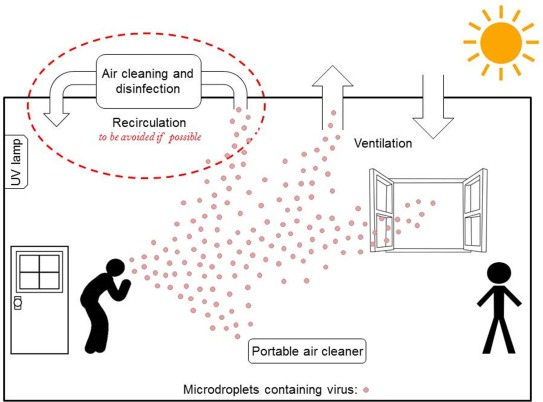
Engineering level controls to reduce the ecology risks for airborne transmission. Source: Environmental International Volume 142. CC By-NC-ND 4.0.
Indirect Contact
Indirect contact includes both vehicle-borne and vector borne contact. A vehicle is an inanimate become-betwixt, an intermediary between the portal of exit from the reservoir and the portal of entry to the host. Inanimate objects such every bit cooking or eating utensils, handkerchiefs and tissues, soiled laundry, doorknobs and handles, and surgical instruments and dressings are common vehicles that can transmit infection. Blood, serum, plasma, h2o, nutrient, and milk likewise serve as vehicles. For instance, food can be contaminated by E.coli if food handlers practise not practice appropriate handwashing techniques afterward using the bathroom. If the food is eaten by a susceptible host, such as a young child or a person with HIV/AIDS, the resulting infection tin can exist life-threatening.
Vector-borne contact is transmission by an animate intermediary, an animal, insect, or parasite that transports the pathogen from reservoir to host. Transmission takes place when the vector injects salivary fluid by biting the host, or deposits feces or eggs in a break in the pare. Mosquitoes are vectors for malaria and West Nile virus. Rodents tin be vectors for hantavirus.
Portal of Entry
Infectious agents go into the torso through diverse portals of entry, including the mucous membranes, non-intact pare, and the respiratory, gastrointestinal, and genitourinary tracts. Pathogens often enter the body of the host through the same road they exited the reservoir, east.g., airborne pathogens from ane person's sneeze can enter through the nose of another person.
Susceptible Host
The concluding link in the chain of infection is a susceptible host, someone at take chances of infection. Infection does not occur automatically when the pathogen enters the torso of a person whose immune system is functioning unremarkably. When a virulent pathogen enters an immune-compromised person, yet, infection generally follows.
Whether exposure to a pathogen results in infection depends on several factors related to the person exposed (the host), the pathogen (the agent), and the environment. Host factors that influence the outcome of an exposure include the presence or absence of natural barriers, the functional land of the immune system, and the presence or absenteeism of an invasive device.
How COVID-19 Spreads
From the start of the COVID-xix epidemic, it was known that the virus spreads via respiratory droplets (infectious agent). In a CDC telebriefing on Feb xiv, CDC's Messonnier said, "Based on what is now known nearly COVID-xix, we believe this virus spreads mainly from person (reservoir) to person among close contacts (defined as about six feet) through respiratory droplets produced when an infected person coughs or sneezes." This is like to the way influenza and other respiratory pathogens spread. These droplets tin can state in the mouths or noses of people (susceptible host) who are nearby or maybe be inhaled into the lungs (portal of entry).
What was not initially known was that asymptomatic people can act as a reservoir for the virus, thus infecting others. Those who do develop symptoms appear to be "shedding significant virus in their oropharyngeal compartment" up to 48 hours before developing symptoms. "This helps explain how rapidly this virus continues to spread beyond the country, because we have asymptomatic transmitters and nosotros take individuals who are transmitting 48 hours before they get symptomatic," said CDC Director Robert Redfield.
A July ix, 2020 scientific cursory from the World Health Organisation titled Transmission of SARS-CoV-2: Implications for Infection Prevention Precautions, indicates that infectious particles much smaller than droplets tin can go airborne and remain suspended in the air for long periods of time. These so-chosen aerosol particles appear to be capable of infecting people who inhale them. WHO reports that outbreaks related to activities in crowded, enclosed spaces "propose the possibility of aerosol manual combined with droplet transmission" during activities such as choir exercise, eating in restaurants, and exercising in gyms.
Viability on Surfaces
Contamination of dry surfaces can serve as transmission road of coronaviruses. Some studies have reported that coronaviruses can survive on metals, glass, plastic ,and fibers for as long as 9 days. COVID-19 tin live in the air and on surfaces between several hours and several days. 2019-nCoV is viable for upwardly to 72 hours on plastics, 48 hours on stainless steel ,and 24 hours on paper-thin. Copper surfaces tend to kill the virus in about iv hours (van Doremalen et al., 2020).
Research further revealed that the virus could survive in aerosol for up to 3 hours subsequently existence coughed out into the air. Furthermore, governments worldwide are quarantining bank notes, as the coronavirus pandemic puts the spotlight on the germ-spreading properties of "real" money. The United States, Republic of korea, and China are taking action amid concerns that the affliction could exist spread by paper money and coins (van Doremalen et al., 2020).
Source: https://www.atrainceu.com/content/2-understanding-chain-infection
0 Response to "1. what are the different portals of entry for a pathogen to enter the body?"
Post a Comment